Patching fixtures
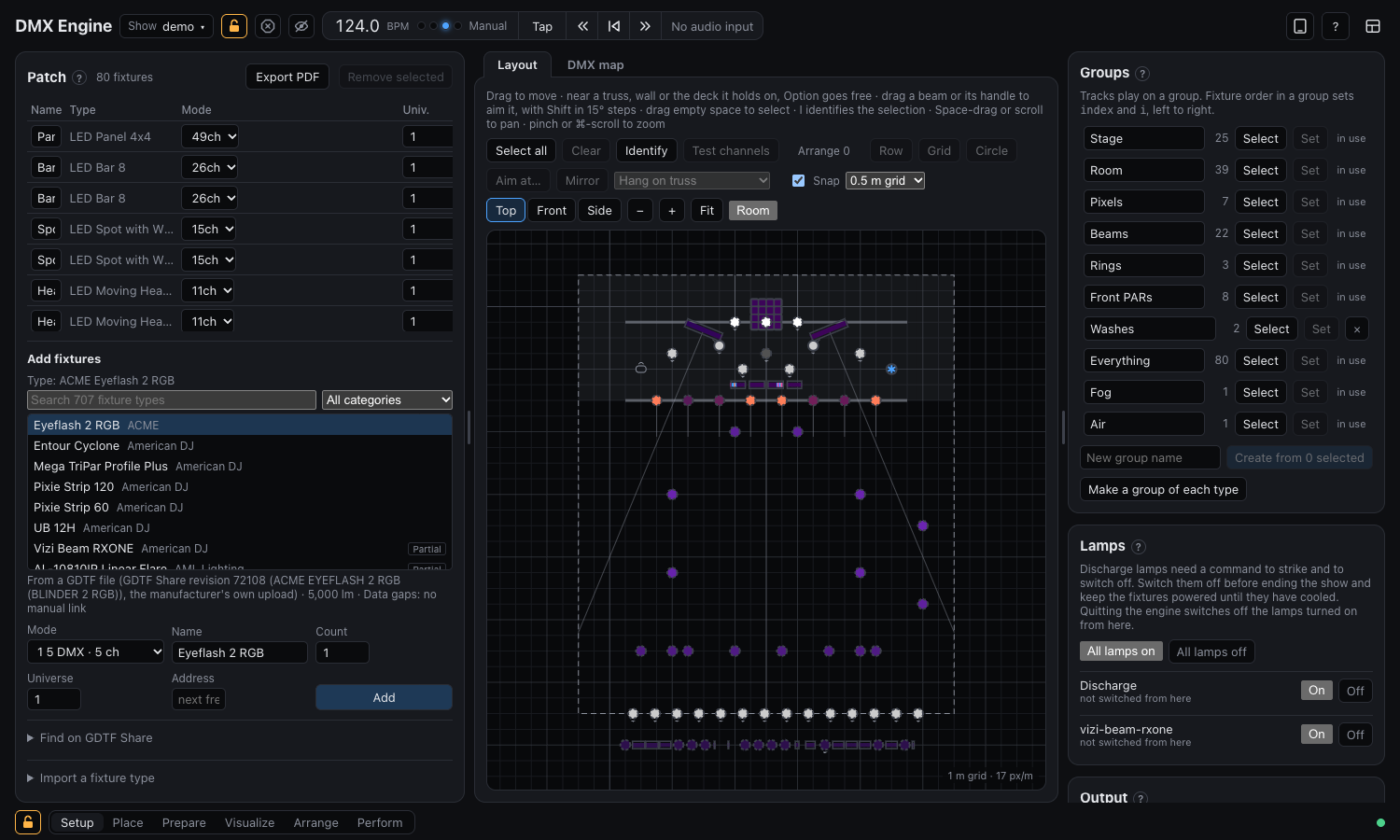
The Setup layout is where you build the rig. Its Patch panel lists every fixture with its type, mode, universe and DMX address. While editing is locked or in blind mode, Setup's panels stay on screen to look at but can't be used, because they work on the real lights.
Add fixtures
Click Add fixtures. The picker searches about 660 fixture types by manufacturer and name, and you can narrow it by category.
- Our own profiles come first. They were checked against manuals or the fixtures themselves, or converted from the manufacturers' GDTF files. Those say From a GDTF file and haven't been checked channel by channel.
- The rest come from a bundled copy of the Open Fixture Library and are marked OFL. The community made them and nobody has checked them on the fixture, so try one with Test channels before a show. Channels the engine doesn't drive yet stay at their default value. Where a profile gives a range for a function (a wheel slot, a stop, a preset), the engine sends the range's first value, because profiles often give wider ranges than the fixture really has.
Badges in the list say how far to trust a type. Tested ones were tried on the real fixture. Partial ones have channels the engine doesn't drive yet, which stay at their default value. Hover over a type, or look below the list once it's chosen, to see what it was checked against, which channels aren't driven, and what its profile leaves out, such as a beam angle the 3D stage would use or pictures for its gobos.
Pick the mode your fixture is set to, and how many to add. A fixture that is missing or newer than the bundled library can be added with Import a fixture type from an OFL file or a GDTF file (.gdtf, as manufacturers publish on GDTF Share). A GDTF file brings its gobo pictures, and says below the file if a mode couldn't come across, such as one that needs two DMX universes. An imported profile replaces a library one with the same key.
Find on GDTF Share fetches GDTF files without leaving the app. Sign in with your own GDTF Share account (free at gdtf-share.com); the engine signs in for you and keeps only the session, not the password, until GDTF Share ends it after about two hours unused. Search by manufacturer or fixture: files the manufacturer uploaded come first, marked Manufacturer, then the newest. Get downloads one and puts it in Import a fixture type, where you check the library key and import it. Sign in from the computer running the engine, or over a network you trust: the password travels from the browser to the engine like the rest of the app's traffic.
Universe and address
Each fixture has a universe and a starting channel. The DMX map (next to Layout above the stage) shows each universe's 512 channels with the fixtures on them, colored by type; channels two fixtures share are hatched.
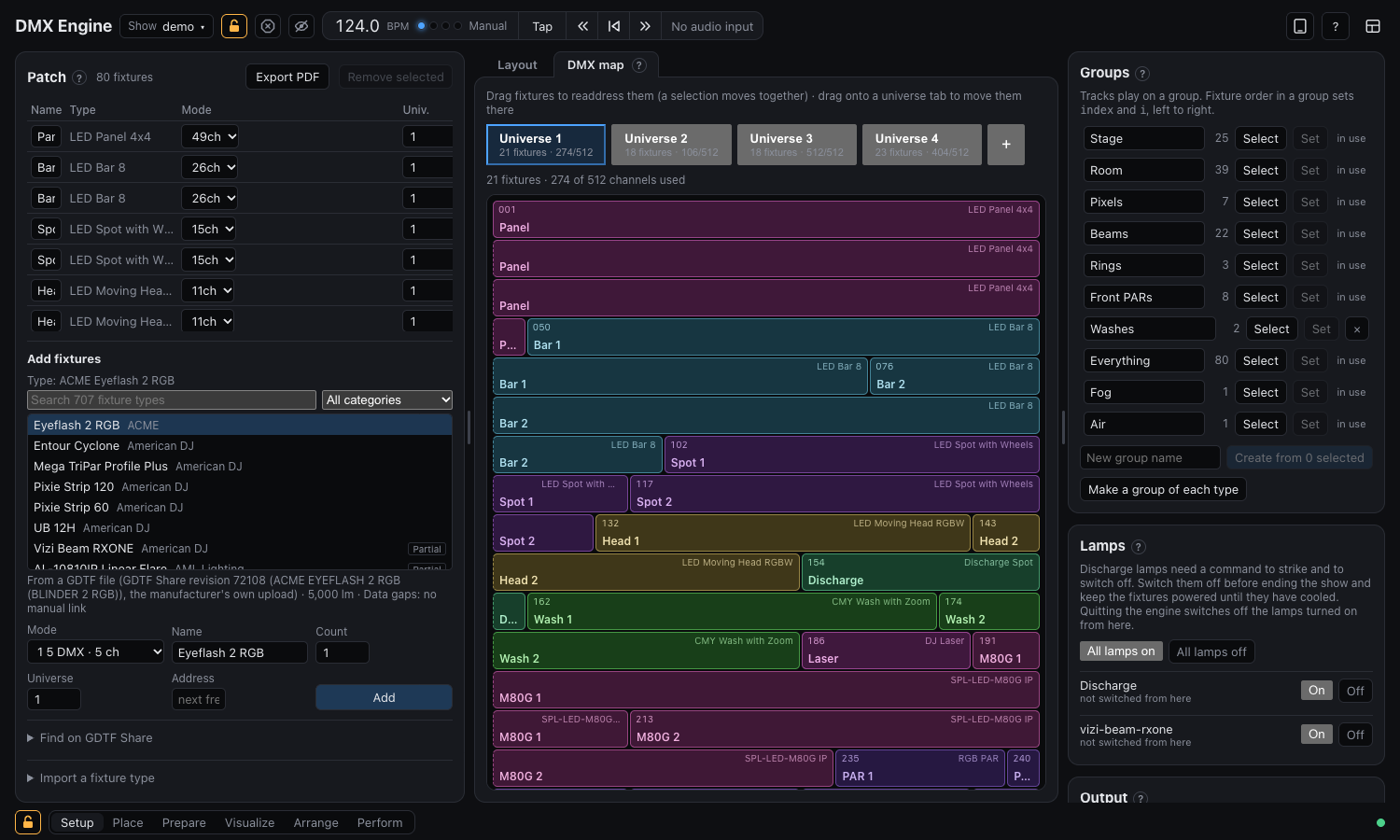
- Drag a fixture to move it to another address. A selection moves together.
- Drag it onto another universe's tab to move it there. + adds an empty universe.
- Fix overlaps moves colliding fixtures to the first free channels.
Each move is one undo step.
Check a fixture
- Identify (the I key, or Identify in the Layout view) lights the selected fixtures white at full, with gobos, prism and strobe cleared. It follows the selection, so you can click down the patch and see each fixture light up in the rig. It ends with I again, Release, switching to a layout without Rig layout, or closing the window.
- Test channels lists the selected fixtures' DMX channels and what each is getting now. Move a slider (or type a value) to hold that channel at a raw value over the show, which is how you find out what an undocumented channel does. × or Release all gives channels back; closing the tester or switching away from Patch releases them all. Several fixtures can be tested together when they share a type and mode.
Even out brightness
The Bright. column is the percentage of its output a fixture gets, after the layers and the grand master. A strong discharge lamp can sit at 40 % next to LED bars. All gives every fixture of a type the same trim in one undo step, and changing the trim of a selected fixture scales the whole selection by the same ratio. A trim only turns fixtures down, so match the rig to its dimmest type. Identify still lights a fixture at full, for comparing.
Lamps
When a patched fixture has lamp commands, the Lamps panel lists it. On and Off (and All lamps on / All lamps off) send the fixture's strike or switch-off command for as long as its definition says it must be held, then give the channel back to the show. Each row shows what was sent and when, with a reminder that most lamps can't restrike while hot.
Lamp commands work while editing is locked and from blind mode. When you quit, the engine first switches off the lamps it turned on and waits for the hold. Keep the fixtures powered until they have cooled.
Print the patch
Export PDF makes a printable A4 patch sheet sorted by universe and channel: names, types, modes, channel ranges and groups, with overlap warnings. The desktop app saves it in Downloads; a browser uses its usual download place.